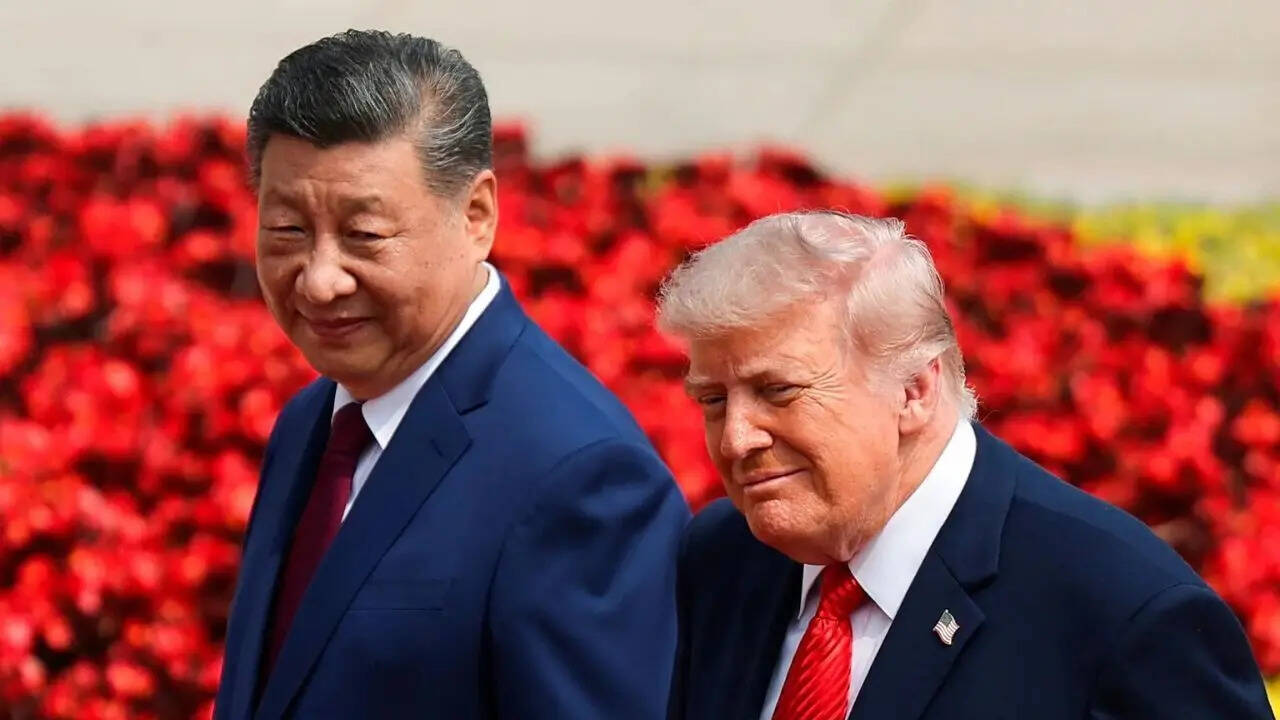


The Art of the kneel: China hands Donald Trump a reality check about its rise



TOI correspondent from Washington: If symbolism is the first language of diplomacy, then US President Donald Trump’s visit to Beijing this week amounted to a geopolitical translation of a changing world order: a confident, ascendant China speaking as an equal — if not superior — power to an American president increasingly eager for accommodation rather than confrontation.The summit between the US President and China’s leader Xi Jinping on Thursday unfolded less like a meeting between a reigning superpower and a challenger than an audience between a cautious petitioner and an imperious host. In carefully choreographed remarks, Xi invoked the “Thucydides Trap” — the theory that war often erupts when a rising power threatens to displace an established one — while pointedly warning Washington against mishandling Taiwan. Trump, by contrast, lavished praise on Xi, extolled future business deals, and emphasized agricultural purchases, investment and trade access. The asymmetry was striking not merely in tone but in substance. China’s official readout of the meeting prominently featured Xi warning that Taiwan remained “the most important issue in China-US relations” and that “Taiwan independence” and peace across the Taiwan Strait were “as irreconcilable as fire and water.” Beijing also stressed opposition to the “militarization of the Strait” and referenced tensions surrounding Iran’s closure of the Strait of Hormuz, triggered by the US-Israeli attack on Iran. The White House readout, however, omitted Taiwan entirely. Instead, the US account highlighted economic cooperation, Chinese purchases of American agricultural products, market access for US firms, cooperation on fentanyl, and expanded business ties. Trump declared that the relationship would become “better than ever before” and spoke glowingly of “a fantastic future.”The divergence underscored what many analysts increasingly see as a dramatic inversion in US-China relations.For years, Washington’s bipartisan foreign policy establishment framed China as the revisionist challenger and the US as the status quo power setting the terms of engagement. But after Trump’s tariff offensives failed to bend Beijing and China weaponized its dominance over rare earth supply chains, the optics in Beijing suggested a different reality: China appearing increasingly comfortable dictating red lines while Washington seeks stability and economic relief.Xi’s invocation of the Thucydides Trap was especially weighted. The phrase originates with ancient Greek historian Thucydides, who chronicled the Peloponnesian War and famously wrote that it was “the rise of Athens and the fear that this inspired in Sparta” that made conflict inevitable. In recent years, political scientist Graham Allison popularized the concept in his 2017 book Destined for War, arguing that structural rivalry between a rising China and an established United States risked catastrophic conflict unless carefully managed.Xi has referenced the concept before, but his use of it in Trump’s presence carried unmistakable symbolism. “Transformation not seen in a century is accelerating,” Xi declared. “China and the United States need to overcome the Thucydides Trap and join hands to create the future.”The subtext was unmistakable: Beijing no longer speaks as a junior player seeking accommodation within an American-led order. It increasingly speaks as a peer power insisting Washington adjust to a multipolar reality.Trump, meanwhile, appeared eager to do exactly that. Far from reviving the hawkish rhetoric that once defined Republican China policy, Trump adopted the language of managed coexistence. “There is no winner in a trade war,” Xi told him — a line Trump did not publicly contest.The shift has left many China hawks inside the Republican Party notably muted. Figures who once warned of existential competition with Beijing have largely fallen silent as Trump pivots toward what some analysts describe as “commander-in-peace” pragmatism toward China, even while flexing military muscle against smaller adversaries elsewhere.“Donald Trump is the key dove,” former Pentagon official Dan Blumenthal observed recently in Politico. “He wants stability. He’s just very impressed with Chinese power and doesn’t believe that we’re in any position at the moment to win a strategic competition.”That assessment has been reinforced by a stream of recent intelligence and military analysis that paint an unsettling picture for Washington. According to a report disclosed this week, the Joint Staff’s intelligence directorate warned its chairman General Dan Caine that China has been selling weapons to key Middle Eastern partners while US stockpiles were depleted defending Gulf allies during the Iran conflict. The analysis reportedly alarmed Pentagon officials because Beijing was effectively arming countries Washington itself was struggling to protect.China has simultaneously expanded its role as an emergency energy supplier – despite the stress it is itself under – after Iran’s closure of the Strait of Hormuz disrupted global markets. Beijing has reportedly stepped in to provide energy support to countries including Australia, Thailand and the Philippines — all US treaty allies or strategic partners. The intel assessment concluded that China had “seized on the 39-day conflict to expand its military, economic and diplomatic influence around the world.”That influence is increasingly visible not only in the Gulf but across Africa, where Chinese infrastructure financing and security partnerships continue to outpace waning American engagement. Decades-old alliances painstakingly assembled by Washington are showing strain amid Trump’s tariff threats, erratic diplomacy and transactional foreign policy style.Even the atmospherics of the Beijing summit reflected the altered balance. Trump, as usual, deployed his trademark superlatives, telling Xi that American CEOs accompanying him — including Elon Musk and Tim Cook — had come to China to “pay respects.” Xi responded with cool restraint.Where Trump personalized and flattered, Xi remained measured and institutional. Where Trump praised the relationship in glowing terms, Xi spoke of “strategic stability,” “managed competition,” and the need for both powers to act “in the same direction.”It was less the chemistry of two friends than the choreography of two powers acknowledging a changing hierarchy — with Beijing increasingly confident that history, economics and strategic momentum are tilting in its favor.
Source link